
NBS Specimen Collection – Special Circumstances
Multiple Births (Twins, Triplets, etc.)
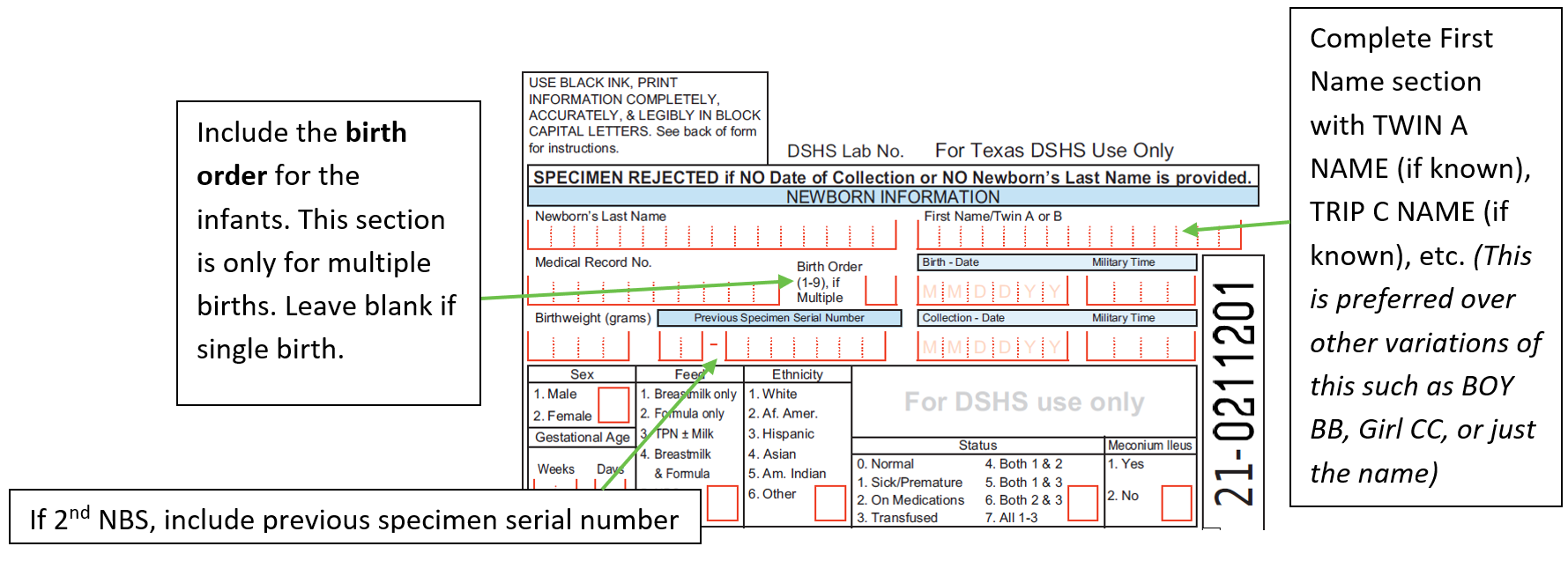
When collecting Newborn Screens for multiple births (twins, triplets, etc.), please take extra care in completing the demographic information.
Accurate information on the demographic form is vital to testing, result follow-up, and linking of patients’ screens. Fill out the demographic form completely and accurately. Important things to remember when collecting specimens for infants of a multiple birth:
Transferred Infants
For infants that need to be transferred to another facility:
- Transferring facility must collect the newborn screen before transfer, unless the baby is so unstable that it cannot be done safely.
- If the screen is not done before transfer the transferring facility must ensure the receiving facility is aware of the need for screening to still be completed.
Transfused Infants
For infants that need to be transfused:
- Collect the first newborn screen before transfusion. Transfusions, even small ones, can impact testing and may invalidate results.
- Collect the second newborn screen as usual; at age 7-14 days of age.
- If the first newborn screen was not collected before transfusion, follow these recommendations:
- Collect a third specimen 3 months post transfusion.
- Or collect when red blood cells can be presumed to be from the baby.
When completing the demographics form, transfusions are noted under status.
.png?cb=1786610696)
- If the first newborn screen was collected before transfusion:
- DO NOT include transfused in status
- For second screens collected on transfused infants:
- Include transfused in status
Infants On Heparin
For infants who are on heparin:
- Heparin and EDTA present in the blood at time of collection may interfere with newborn screening test methods.
- Results may be reported as unsatisfactory and require a repeat collection.
When completing the demographics form note that the newborn is ‘On Medications’ under status.

View a complete Newborn Screening Analyte Interference List from APHL.
Premature Infants
Premature infants may have persistent abnormalities in newborn screening test results without having an abnormal condition, however:
- A premature infant with abnormal screening results should be re-screened at the time of discharge or when requested by the Newborn Screening program (whichever comes first).
- Physical or metabolic signs suggestive of the presence of a screened condition should immediately prompt appropriate diagnostic testing for the suspected disorder.
Infants on Total Parenteral Nutrition (TPN)
- When possible, collect the newborn screen before initiating TPN.
- If the screen is not collected prior to TPN, the specimens should be collected at the 24-48 hour period as long as they are collected by heel stick. DO NOT COLLECT DIRECTLY FROM THE TPN LINE.
- TPN may interfere with the newborn screen by causing elevated results for many of the analytes masking a true disorder, particularly with the Amino Acid Disorders.
- If an infant is on TPN, please note this on the demographic form of the Newborn Screening Kit in the “Feed” section.
Infants with Casts on Both Feet
- If the infant’s 1st screen was normal, obtain the 2nd screen when the casts are changed or removed.
- If the infant’s 1st screen was abnormal, follow Newborn Screening Clinical Care Coordination guidelines.
- If the infant’s 1st screen was unsatisfactory, follow Alternative Methods for Collecting a Newborn Screen Guidelines.
Infants Adopted / Fostered / Wards of State
If an infant is adopted, fostered, or is a ward of the court or state:
Complete the Demographic Information of the Specimen Collection Form as follows:
- “Mother’s Information” – enter information to reflect who the child will be in the care of upon release from the healthcare facility.
- Mother’s contact information – enter contact information for the child’s caregiver in the event follow-up is needed.
- If the 1st screen kit/serial number is known, enter in the “Previous Specimen Serial Number” section of the demographic form of the Newborn Screening kit.
The screening can be done up to a year old if it is not known whether the child had one or either of the screens.
Collecting the Newborn Screen (NBS) on Older Infants
The Texas NBS Laboratory accepts specimens collected on older infants, however, keep the following in mind:
- Texas is a two-screen state. Texas law requires every baby to receive newborn screening blood-spot-based tests for the conditions on the state newborn screening panel. The birth facility or midwife collects the first screen when the baby is 24 to 48 hours of age. A pediatrician or other health care professional collects the second screen when the baby is 7 to 14 days of age, a minimum of 168 hours.
- If the infant misses the second NBS window between 7 and 14 days of age, pediatricians and other health care professionals should still collect a second newborn screen as soon as possible.
- Perform the screen via heel stick unless the infant is walking. If the infant is walking, collect the specimen by an alternative method following standard blood collection practices. For more information visit Alternative Methods for Collecting a Newborn Screen webpage.
- Newborn screening targets newborns and young infants. Testing outside the recommended age range may not detect all screened conditions. If there is a clinical concern, start diagnostic testing without delay. The physician makes the final determination to proceed with newborn screening or diagnostic testing.
Other Resources
- Newborn Screening Clinical Care Coordination Home
- Request FREE Specimen Collection Educational Materials
- Texas Health Steps (THSteps) NBS Module - Online Provider Education
To access the newborn screening module: From the Provider Education Homepage, select "Available Courses" and follow the newborn screening link. - General Specimen Collection Requirements
- Alternative Methods for Collecting a Newborn Screen