
Plague (Yersinia pestis)
This page provides information about Plague (Yersinia pestis) .
Disease Surveillance and Epidemiology Section
Zoonosis Control Diseases & Conditions
- Animal Friendly Program
- Echinococcosis
- Flea-borne Typhus
- Leishmaniasis
- Leptospirosis
- Psittacosis
-
-
-
- Rabies Epi-Annual Reports
-
- 2026 Monthly Rabies Reports
- 2025 Monthly Rabies Reports
- 2024 Monthly Rabies Reports
- 2023 Monthly Rabies Reports
- 2022 Monthly Rabies Reports
- 2021 Monthly Rabies Reports
- 2020 Monthly Rabies Reports
- 2019 Monthly Rabies Reports
- 2018 Monthly Rabies Reports
- 2017 Monthly Rabies Reports
- 2016 Monthly Rabies Reports
- Rabies Facts
-
- Tapeworm (Taeniasis / Cysticercosis)
- Trichinellosis (Trichinosis)
Plague (Yersinia pestis)
Description
Plague (Pestis)
ICD-9 020; ICD-10 A20
Plague is a disease caused by microorganisms (germs) called bacteria. It is usually passed between rabbits and rodents, such as rats, mice, prairie dogs, and squirrels, by the bite of an infected flea. The disease can be passed to people and cats by flea bites. People and cats can also get plague by coming in contact with animals that have plague or have died from the disease.
General Information & Resources
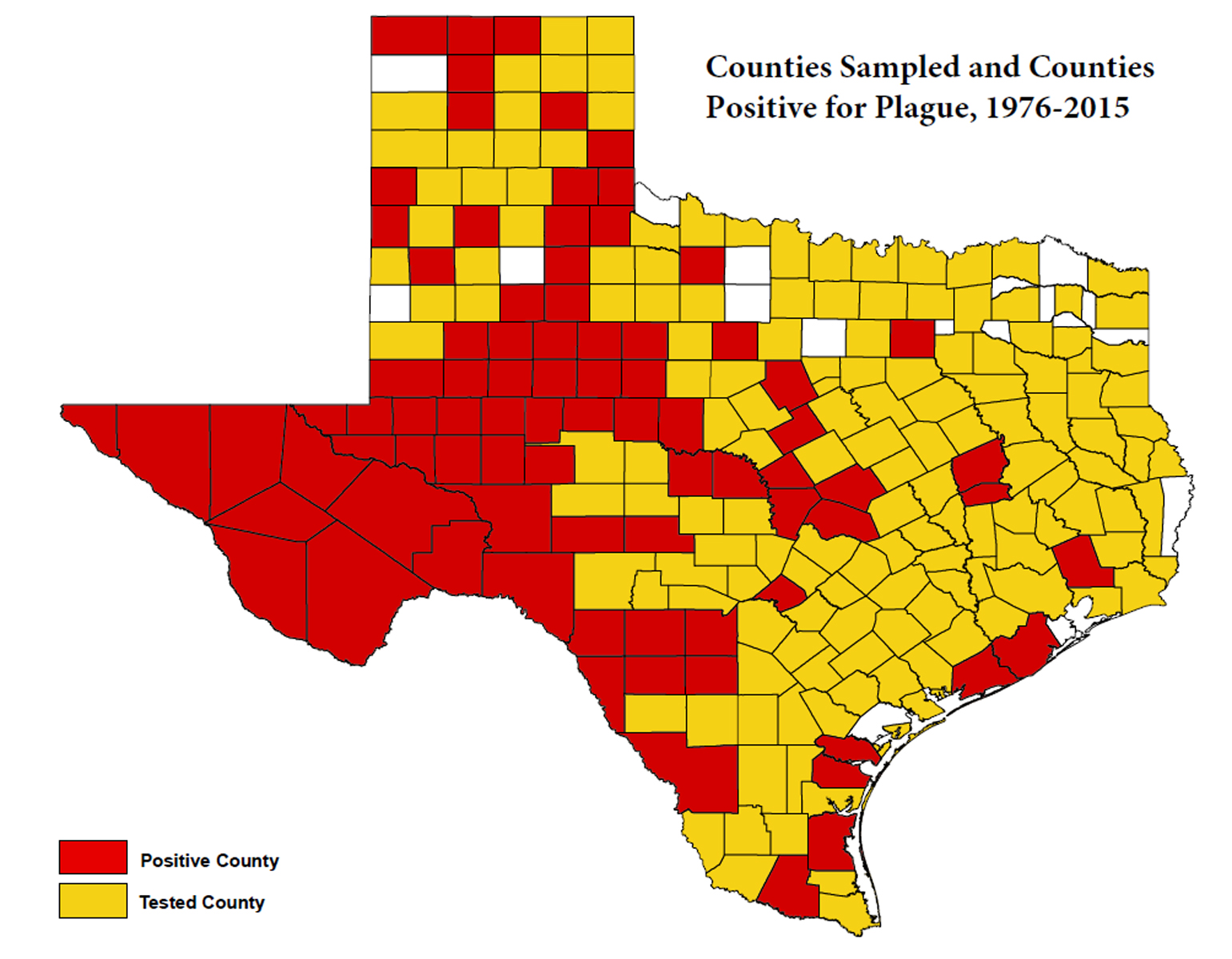
Map
Geographical distribution of plague in Texas.
Plague Information for Healthcare Providers
Useful fact sheet on plague.
Several Texas laws (Tex. Health & Safety Code, Chapters 81, 84 and 87) require specific information regarding notifiable conditions be provided to the Texas Department of State Health Services (DSHS). Health care providers, hospitals, laboratories, schools, and others are required to report patients who are suspected of having a notifiable condition (Title 25, Texas Administrative Code, Chapter 97, Subchapter A).
Report Plague immediately by calling 800-705-8868 or 800-252-8239.
Zoonotic Case Investigation Forms - Plague report forms for humans (Plague Case Investigation Form) and animals (Report Form for Zoonotic Diseases in Animals) are available.
- Plague Information
Centers for Disease Control and Prevention, Bioterrorism Preparedness and Response PlanningFact Sheets, Overviews, & FAQs (Frequently Asked Questions), Diagnosis & Evaluation, Infection Control, Laboratory Testing, Surveillance & Investigation
-
Pamphlet
Pamphlets covering basic information on plague (#7-36 Facts About Plague [English]; #7-36a Informacion Sobre La Peste [Español]) -
Map
Geographical distribution of plague in Texas.
Frequently Asked Questions
Bubonic plague is the most common form. People usually get it from a flea bite. It can cause swelling in the neck, under the arm, or in the groin area. The swellings are called “buboes” and are sore when touched.
Septicemic plague occurs when the plague bacteria get into the blood. This could happen through an open cut on the skin. People get very ill with this form of plague.
Pneumonic plague is the least common, but most dangerous, form of plague. In this form, the bacteria get into the lungs and can be easily passed from one person to another through coughing and sneezing. Cats can get this form and pass it to people as well.
About 2 to 6 days after being bitten by an infected flea, a person with plague will have fever, restlessness, confusion, extreme tiredness, and other flu-like symptoms. A few days later, one or more buboes may develop. If the person is not treated by a doctor, they may become very ill and even die.
Yes. Plague has been found in the western two-thirds of Texas where there are squirrels, prairie dogs, rabbits, rats, and mice. If a large number of these animals are found dead or dying, plague may be the cause. Plague in people is rare.
You cannot. Do not handle sick or dead wild animals. If you have a sick cat, take it to a veterinarian right away. If you see large numbers of dead or dying animals in your area, call your local health department or regional Texas Department of State Health Services office. The animals can be tested for plague.
-
Prevent fleas in and around your house and on your pets. Call a veterinarian to learn about flea control products you can use.
-
Remove places around your house where rabbits, rats, and mice could live, such as piles of trash and high weeds. Patch any holes in your house where rats, mice, or squirrels could enter. Do not leave dishes of pet food where they could attract wild animals. Store pet food in containers with a tight lid and remove pet dishes after your pet has eaten.
-
Use flea control before killing any rodents. If you kill the rodents first, their fleas could get on you or your pets.
If you hunt, fish, camp, or otherwise visit an area where there is plague:
- Use insect repellent. Follow the directions on the container carefully.
- Protect your pets with a safe flea control product or leave your pets at home.
- Remember, people can get plague from direct contact with an animal that has the disease. If your cat has swollen lymph nodes, an abscess-like wound, coughing, or sneezing, do not place the animal’s face close to yours. Contact a veterinarian for advice.
- Avoid all contact with rabbits, prairie dogs, squirrels, mice, rats, or other wild animals. Do not feed them!
- Avoid contact with fleas. Do not camp, rest, or sleep near animal burrows.
- Wear gloves if you are hunting and must handle wildlife.
- Do not touch sick or dead animals.
- If you see a large number of dead or dying animals, call your local health department or regional Texas Department of State Health Services office.
- Call a doctor if you get sick within a week of visiting an area with plague. If you have plague, a doctor can treat you for the disease.
This information is also available for download (PDF, 115Kb) 08/06 Stock #7-36.
Get in Touch
Mailing Address
Department of State Health Services
Zoonosis Control Branch
PO BOX 149347 - Mail Code: 1956
Austin , TX 78714-9347
United States
Physical Address
Department of State Health Services
Zoonosis Control Branch
1100 W. 49th Street, Suite T-502
Austin , TX 78756-3199
United States
